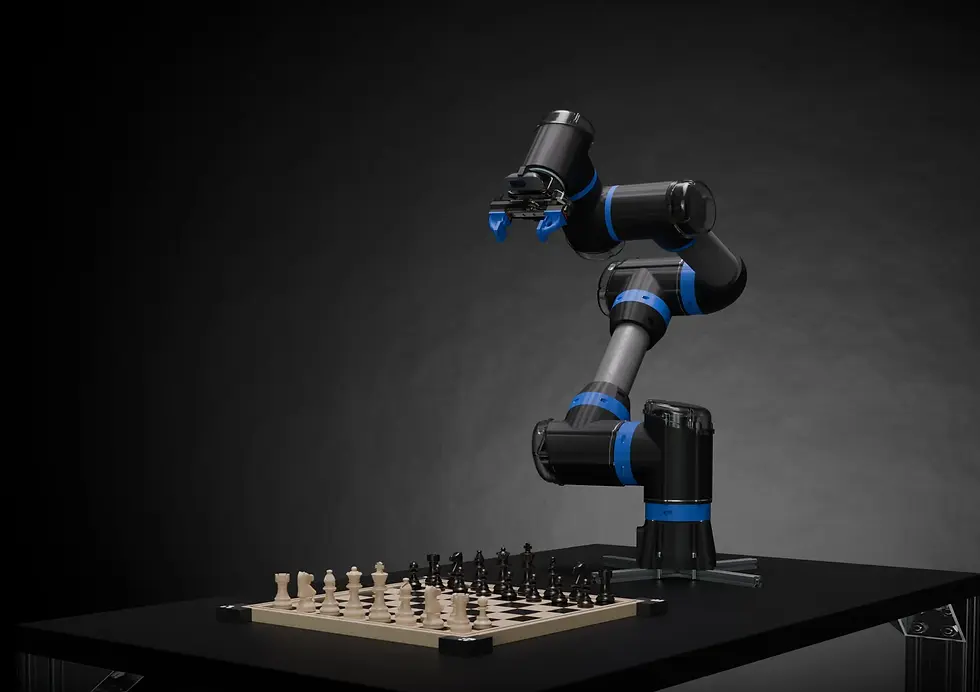
CORA
Open-source modular robotic arm platform
A cost efficient, mostly 3D-printable modular robotic joint system. Each joint is its own package containing an actuator and easy to assemble external connectors.
The system is designed with the intent that users can mix and match the joints in any position and orientation as to make a manipulator that is unique to their project and matches the exact requirements.
Currently the system consists of a pair of revolute joints, standard attatchments, a ROS2 and Python api, and a configurator app wherein users configure their manipulator.
By cutting out the need for mechanical design and prototyping from scratch, CORA offers convenience by streamlining the robotics engineering workflow, while also offering unique solutions to each user.
Status
CORA currently consists of two revolute joint types, a set of standard attachments, a ROS 2 and Python (codi) API for control, and a desktop Configurator app for assembling arms from the joint library before touching hardware.
We’re mid-way through our V0.1 prototype milestone: new joint connectors and gearing, a bill of materials, and a physical build are all in progress.
Recent Milestones: we’re finalizing a V1.x hardening pass a driver-stack upgrade and a public documentation site, ahead of a v1.0 demo. We’re also in early collaboration talks with a precision motion-control manufacturer on motors and gearing, and preparing a FAST Funding 2026 application to support the next phase of development.
Context
What makes us different?
Most “modular” robotic arms are modular at the product level. Meaning you choose between a handful of fixed configurations. CORA is modular at the joint level: any joint in our library can be combined with any other through a shared mechanical and electrical connector standard, so builders assemble an arm shaped for their exact task rather than picking a preset.
Gap in the market
Commercial cobots are expensive, closed-source, and rarely reconfigurable, while most open-source robot arms are static, single-purpose designs that have to be redesigned from scratch for every new application. There’s no accessible, genuinely modular, open-hardware option in between.
The solution
CORA closes that gap with a standardized, mostly 3D-printable joint library, a ROS 2 and Python API, and a configurator app that turns a joint selection into a simulate-able, plannable robot. Making design and prototyping completely optional parts of the workflow for every new arm.


Timeline
Prototype complete
Jan
2026
Spent six months designing a single, non-modular cobot-style arm from scratch. Realized that any design change required a full rebuild, and after speaking with professors, saw the potential for a joint-based, modular approach instead. One joint library that could become hundreds of different robots. This insight became the origin of CORA.
Working Python Interface
Feb
2026
CoDI (Cora Desktop Interface) had a first working version released. This started in the six months before the project but reached a significant functional milestone. Now users without Ubuntu or ROS can control the arm.
Core Architecture
Feb
2026
Figured out how the platform would work at both a software and hardware level: a library of distinct joint types, each built to a standardized interface, that could be combined together in different configurations to form a working manipulator. This concept became the foundation the rest of the platform was built around.
The First Recruitment
Mar
2026
Recruited a team of talented individuals to take on the challenge of developing this open source project. The team at this point consists of two mechanical engineers and one mechatronics/software engineer The first phase involves continuing to work on and finishing the first prototype which had six months of work already put into it.
Cycloidal Drive Prototype
Mar
2026
Designed a wolfrom style cycloidal drive as the first candidate actuator for the joint library. The design was ordered and built, but the actuator did not perform as intended, so the approach was later set aside in favor of alternative drive designs.
A New Partner
May
2026
Allied Motion, a motor manufacturer, reached out to request a demo model showcasing their motors integrated into CORA’s joints. The connection came through a representative from Breda Robotics, who attended one of RSA’s project evenings and introduced the opportunity to the team.
Allied Motion Meeting
Jun
2026
First meeting with allied motion to discuss their vision and requirements. we had overall made a very good impression and they offered us a full sponsorship for the collaboration. It is now up to us to make an appropriate motor selection based on the task and relay this information back to them
Working Communication
Jun
2026
Established CAN bus communication between joints and got the ROS 2 Jazzy control stack operational with real encoder feedback on a working prototype joint, validating that the standardized joint interface works reliably in practice.
CORA Configurator
Jul
2026
Development was started on a new tool that will empower users to design their own arm in a 3D viewer, then export required modular packages and documents in order to be able to build and control their arm. This also enabled us to think deeper about the software architecture and what exactly needs to be static and what doesn’t
Six Joints Fully Assembled
Sep
2026
Finalized the design of the back shells a week prior. For our first 6-dof prototype, six joints were then promptly soldered correctly and assembled.
First Prototype Fully Assembled
Sep
2026
The first prototype has been assembled and is ready for show during the Q1 RSA project evening. After solving many issues with communication and calibration the joints finally had the will to be assembled and put to use.
CORA Configurator V1 Release
Nov
2026
Complete the CORA Configurator, automatically generating the CAD assembly, ROS 2 software stack, and simulation environment from a user’s configuration file, so future arms can be built without manual integration work.
CORA Debut at [Undisclosed RSA Event]
Apr
2027
Demonstrate the full pipeline on a large scale live at [Undisclosed event]. The user configures an arm, the software generates everything needed to build and run it, and the resulting robot is assembled and operated on the spot.
CORA V1 Release
Jun
2027
Publicly release the stable version CORA, free of hardware and software bugs including a full documentation site and build guides, aswell as working configurator and CoDI. Expand the joint library so external student teams and researchers can build their own manipulators on top of the platform rather than starting from scratch. This also kickstarts a massive push in terms of outreach. At this point awareness of our project in european robotics and beyond is necessary to really have a positive impact.
Open Roles
Software Engineer (Configurator)
The CORA Configurator is the desktop application that turns a user’s joint configuration into a complete, ready-to-build robot: CAD assembly, ROS 2 software stack, and simulation environment, all generated automatically. We’re looking for a software engineer to help build this out.
The Configurator is built on a React and TypeScript frontend with a FastAPI backend, packaged as a desktop app with Electron. You’d work across this stack to expand what the tool can do, from improving the configuration and preview experience to strengthening the pipeline that generates CAD, URDF, and control software from a single configuration file. You’d also help resolve outstanding issues as the tool moves from prototype toward a stable release others can rely on.
Team Manager
CORA is growing into a multi-domain project spanning mechanical design, electrical engineering, software, and outreach, and we’re looking for a team manager to help keep it all moving in the same direction.
You’d coordinate across subteams to keep priorities aligned and deadlines realistic, track progress against our roadmap toward the Q3 demo, and help manage external commitments like the Allied Motion collaboration and outreach to TU Delft faculty. This role suits someone who wants to develop project management and leadership experience while staying close to a real, ambitious hardware and software project.
Electrical/Mechatronics Engineer
The prototype is currently on track to reach a fully functional state, but there’s significant room to improve its performance by developing several electrical subsystems for the joints and other core components. This is where you’d come in.
You will help develop a new system for automatically detecting and configuring joints in an assembled arm, for example using NFC readers embedded in each joint or another detection method, to remove manual configuration steps and make the build workflow significantly faster and easier.
Furthermore, the project also needs a modular power supply solution. Because as arms grow and scale, power requirements change.
We also have an ongoing collaboration with Allied Motion, a motor manufacturer, who has asked us to build a demo model using their motors. This project needs a mechatronics engineer to design custom actuators and joints around Allied Motion’s hardware.
Executive Affairs Officer
CORA is actively pursuing university support, funding, and industry partnerships, and we need someone to help manage these relationships as the project scales.
You’d support the team with tasks like preparing and submitting funding applications (such as FAST Funding), coordinating faculty outreach at TU Delft, and helping manage communication with external partners like Allied Motion. This role is a good fit for someone interested in the business and administrative side of running an ambitious student project, without needing a technical background.
Application Details
CORA is open for recruitment. We’re looking for a robotics software engineer, a web developer, a mechatronics engineer, and a project manager to help us reach v1.0.
Contact
E-mail us at cora@rsadelft.nl with a short note on your background and what you’d like to work on. You can also follow our progress on GitHub and Instagram
Application
Find us at
Website


GitHub


YouTube
The Team
Department

Name
Role